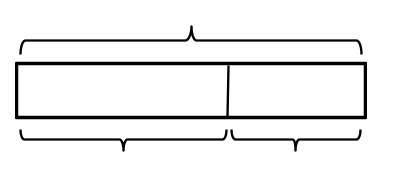
fill in the blanks.

Angles are often thought of as easy questions that require little practice.
That is a common misconception of many P5 and P6 students.
Without practice, one will not be able to remember the rules easily.
Questions like these will often appear in Paper 1.
Calculator usage will not be allowed.
| Diagram may not be drawn to scale |
| Uno Reverse Cards |
To assist P3 and P4 Math students with comparison model drawing,
such visual aids may be useful.
Instead of having them draw the model,
have them fill in a partially drawn model first.
If the student is able to fill in all the missing boxes, the model should be able to instruct them on how to find the answer.
The following is designed to help students visualise more than/less than questions by using comparison models.
These few questions may look identical
but these numbers given are representing different parts of the model.
Draw the comparison models and fill up all the empty boxes in each model
Q1)
Ali has $78.
Ben has $30 more than Ali.
How much do they have altogether?
Q2)
Ali has $78 more than Ben.
Ben has $30.
How much does Ali have?
Q3)
Ali has $30 less than Ben.
Ben has $78.
How much do they have altogether?
Q4)
Ali and Ben have $78 altogether.
Ali has $30 more than Ben.
How much does Ben have?
Q5)
Ben has $78 more than Ali.
Ali has $30.
How much do they have altogether?
Q6) Ali has $30 more than Ben. Ben has $78. How much money do they have altogether?
Q7) Ali and Ben have $78 altogether. Ben has $30. How much more money does Ali have than Ben?
Q8) Ali has $78. Ben has $30 How much more money does Ali have than Ben?
| Draw this model for each question and fill up the blanks with information from the question |
The following is designed to help students visualise subtraction and addition by using part/whole models.
These few questions may look identical
but these numbers given are representing different parts of the model.
Draw the part/whole models and fill up all the empty boxes in each model
Q1)
Bella has $100.
She bought a book and had $15 left.
How much was the book?
Q2)
Bella spent $15 to buy a magazine and has $100 left.
How much did she have at first?
Q3)
Bella has some money at first.
She received $15 from her father and now she has $100.
How much money did Bella have at first?
Q4)
Bella wanted to buy a bag that costs $15.
How much change would she get if she gave the cashier a $100 note?
Q5)
Bella paid for the pair of shoes with $100 and received $15 change.
How much did the pair of shoes cost?
Q6) Bella bought a chair that costs $15. She also bought a table that costs $100. How much did she pay for the 2 items altogether?
| Draw this above model for each question and fill up the blanks with information from the question |

These few questions may look identical
but these numbers given are representing different parts of the model.
Draw the comparison models and fill up all the empty boxes in each model
Q1) Basic
Alan has 4 times as much money as Beth.
Beth has $840.
Q2) Intermediate
Alan has 4 times as much money as Beth.
Alan has $840.
Q3) Advance
Alan has 4 times as much money as Beth.
They have $840 altogether
Q4) Expert
Alan has 4 times as much money as Beth.
Beth has $840 less than Alan.
![]() |
| Fill up all the empty boxes and write down each total |