Showing posts with label subtraction. Show all posts

P6 Math: 2 Overlapping Right-Angled Isosceles Triangles with Area Difference given

Though this question looks seemingly like a triangle question, it'd actually require the knowledge of area of squares.

Such questions are common in Paper 1 of P6 Prelim papers.
Calculator usage is not allowed.

Triangular tiles forming Square patterns


The question below will randomize with different numbers every hour. 
Copy below question down before making attempt.


Click  if above box appears blank


P5/P6 Math: Revisting Before and After Ratio ( Both Parties Change )

This question type is similar to the one posted here.

There are 2 values being compared using ratio and each of them undergo addition or subtraction and the ending ratio is also provided.

Such questions are common in Paper 2 of P6 exams.
Calculator usage is allowed.

Eric and Tyra were given money by their father in the ratio of 7:2. 
After Eric spent $165 and Tyra was given $210 more, 
the ratio of Eric to Tyra's money at the end became 2:7. 

How much did Tyra have at first?


If the above question is easy, try to do the more challenging question below.

The question below will randomize with different numbers every hour. 
Copy below question down before making attempt.


Click if above box appears blank

P5 Math: Fractions Weighted Assessment 1

Usually at the end of Term 1, the P5 cohort will be taking a weighted assessment (WA1) that will test their ability to handle fraction problem sums.

The following few examples are common questions that addresses different aspects of P5 Fractions.

Calculator usage will not be allowed for such questions as workings are needed in order to solve.


The questions below will randomize with different numbers every hour. 
Copy below question down before making attempt.


P5/P6 Math: Starting Total and Ending Ratio (Basic)

The question type below provides the student with the starting total between 2 parties and the ending ratio after each of them undergo some changes. One of the value will undergo a fractional decrease and the other will have some value added or subtracted.

Students will need to "start from the end" in order to solve. (aka working backwards)

Such questions are common in Paper 2 of P5 and P6 papers.
Calculator usage is allowed.

Similar questions of this type can also be found here.

Moorthi and Devi have a total of 1093 invitation cards to send out.
After Moorthi sent out 1/3 of his cards and Devi sent out 444 cards of her cards,
the ratio of Moorthi's to Devi's remaining cards was 4:5.

a) How many cards did Moorthi sent out?
b) How many cards did they have left altogether at the end?


If the above question is easy, try to do the more challenging question below.

The question below will randomize with different numbers every hour. 
Copy below question down before making attempt.


Click if above box appears blank


P6 Math: Before and After Ratio (Expert)

A total of 3 ratios are given for this question type.

Starting ratio (before), ending ratio (after) and the ratio of change will be given for such questions.

Such questions will appear in Paper 2 of P6 Math exams.

Calculator usage is allowed.


Robin have a total of 384 grapes and berries in the ratio of 5:3 respectively.

He then gave away some grapes and bought more berries in the ratio of 2:1.

After that, the ratio of grapes to berries became 1:1.

How many grapes were given away?


If the above question is easy, try to do the more challenging question below.

The question below will randomize with different numbers every hour. 
Copy below question down before making attempt.


Click if above box appears blank

P3 Math: Comparison Model Drawing Exercise (More Than/Less Than)


The following is designed to help students visualise more than/less than questions by using comparison models.

These few questions may look identical 

but these numbers given are representing different parts of the model.

Draw the comparison models and fill up all the empty boxes in each model


Q1) 
Ali has $78. Ben has $30 more than Ali. How much do they have altogether?


Q2)
Ali has $78 more than Ben. Ben has $30. How much does Ali have?


Q3)
Ali has $30 less than Ben. Ben has $78. How much do they have altogether?


Q4) 
Ali and Ben have $78 altogether. Ali has $30 more than Ben. How much does Ben have?


Q5)
Ben has $78 more than Ali. Ali has $30. How much do they have altogether?


Q6) Ali has $30 more than Ben. Ben has $78. How much money do they have altogether?


Q7) Ali and Ben have $78 altogether. Ben has $30. How much more money does Ali have than Ben?


Q8) Ali has $78. Ben has $30 How much more money does Ali have than Ben?


Draw this model for each question and
fill up the blanks with information from the question

P3 Math: Part/Whole Model Drawing Exercise


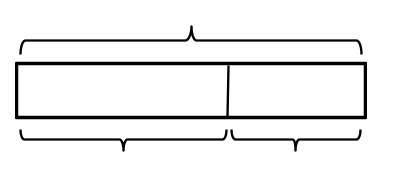
The following is designed to help students visualise subtraction and addition by using part/whole models.

These few questions may look identical 

but these numbers given are representing different parts of the model.

Draw the part/whole models and fill up all the empty boxes in each model


Q1) 
Bella has $100. She bought a book and had $15 left. How much was the book?


Q2)
Bella spent $15 to buy a magazine and has $100 left. How much did she have at first?


Q3)
Bella has some money at first. She received $15 from her father and now she has $100. How much money did Bella have at first?


Q4) 
Bella wanted to buy a bag that costs $15. How much change would she get if she gave the cashier a $100 note?


Q5)
Bella paid for the pair of shoes with $100 and received $15 change. How much did the pair of shoes cost?


Q6) Bella bought a chair that costs $15. She also bought a table that costs $100. How much did she pay for the 2 items altogether?

Draw this above model for each question and
fill up the blanks with information from the question


P4/P5 Math: Before and After: Start Same but End with Multiples

The following question is a P4 and P5 question that does not require a calculator.

This is a "before and after" model drawing exercise where both parties starts with the same amount but after each add or subtract different amounts from their total, the story ends with one being a multiple of another.

Derek and Becky baked the same number of loaves of bread at first.
After Derek sold 20 loaves and Becky gave away 80 loaves,
Derek now has 4 times as many loaves of bread left as Becky.

How many loaves of bread did both bake altogether at first?

If the above question is easy, try to do the more challenging question below.

The question below will randomize with different numbers every hour. 
Copy below question down before making attempt.


Click if above box appears blank

Click here to register for Mr Neo's class

P3 Math: Total Given After Subtraction and Addition

This question type is a simple before and after question that requires students to be able to comprehend what 2 mathematical functions (subtraction or addition) must be performed to get the total that was given at first(aka before).

Such questions usually will appear in Section B or C of P3 exam papers.

The train left Ang Mo Kio station with some passengers.
When the train reached Bishan station,
433 passengers alighted.
When the train reached Braddell station,
100 passengers boarded the train.

There were 645 passengers altogether on the train 
after the Braddell station passengers boarded

How many passengers were there on the train 
when the train left Ang Mo Kio station?


If the above question is easy, try to do the more challenging question below.

The question below will randomize with different numbers every hour. 
Copy below question down before making attempt.


Click if above box appears blank

Click here to register for Mr Neo's class

P3 Math: Part Whole Model with Total Height(or Length) given

The question type below tests the ability of P3 students to draw and label a Part Whole model with the information included.

Height/Length is given in both m and cm to ensure that they are able to perform such conversions between metres and centimetres effectively

With the heights(lengths) information given, students must piece together the information to construct a part whole model that conforms with the information presented in the question.

Such questions often appear in P3 WA2 or SA2 and will appear in Section C of the P3 Exam paper

Larry had 4m 2cm of ribbon at first.
He used 80cm of the ribbon to tie a present.
He gave 2m 43cm of the ribbon to Eddie.

What length of the ribbon did Larry have left now?


If the above question is easy, try to do the more challenging question below.


The question below will randomize with different numbers every hour. 
Copy below question down before making attempt.


Click if above box appears blank

P5/P6 Math: Ratio: Both Parties Change

The question below deals with the ratio, where both parties undergoing changes via addition or subtraction. Both the starting ratio and ending ratio will be given.


Such questions will appear in exams once after ratio techniques are taught in P5.

Calculator usage is allowed.

A similar version of this question can also be found here.

Jason and Alan each bought some flowers
in the ratio of 1:3 respectively.
Jason gave away 12 flowers and Alan gave away 18 flowers.
The ratio of Jason's flowers to Alan's flowers became 2:9.

How many flowers did they buy altogether at first?


If the above question is easy, try to do the more challenging question below.


The question below will randomize with different numbers every hour. 
Copy below question down before making attempt.


Click if above box appears blank